Picture this. You’re writing a real estate listing and type “beautiful rooves.”
Something feels off. You try “roofs.” That looks odd too.
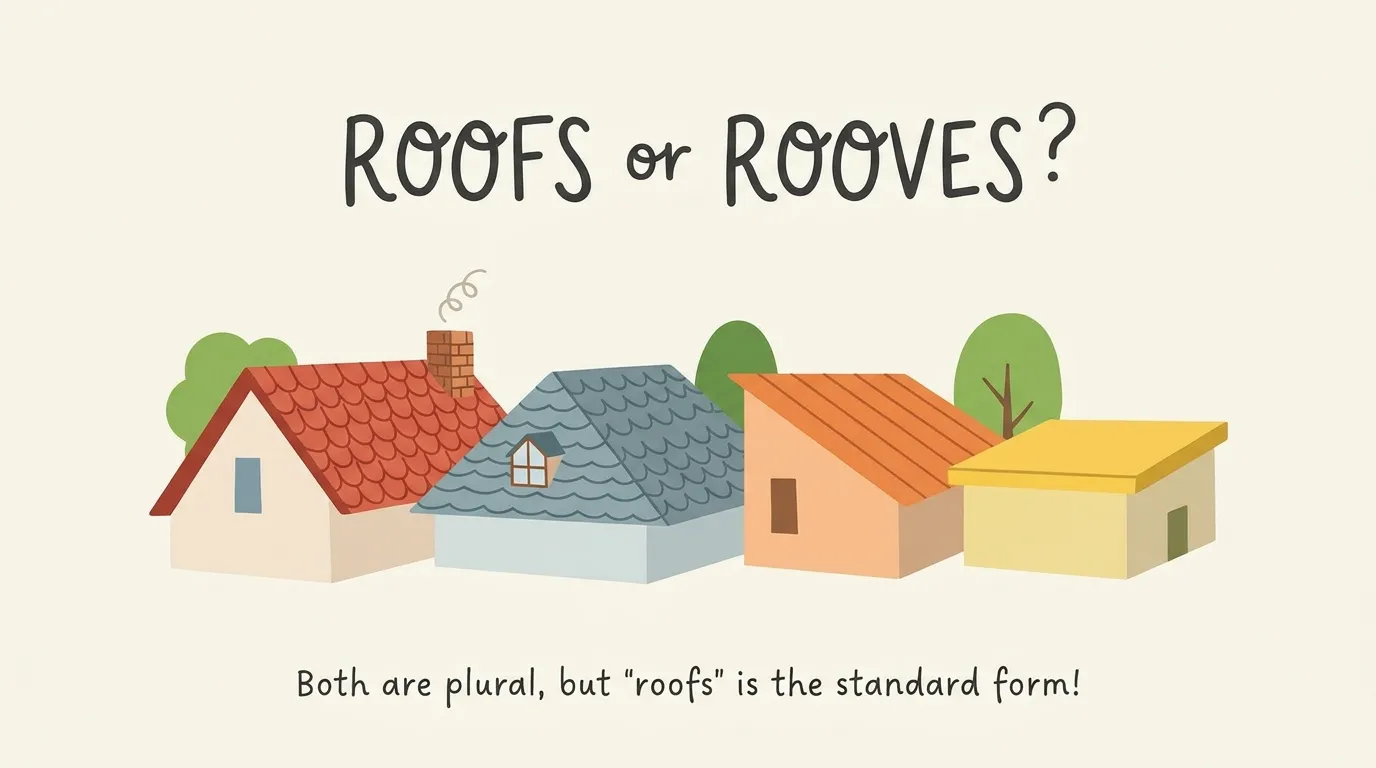
The correct plural of “roof” is “roofs.” It’s standard in both American and British English.
“Rooves” appears now and then. Major dictionaries treat it as rare or nonstandard.
The confusion makes sense. Many words ending in -f change to -ves, like “leaf” and “leaves.”
So “rooves” feels logical. It just isn’t the rule here.
This guide shows you why, and how to remember it.
Table of Contents
- Did You Know?
- Quick Answer
- Quick Rule in 1 Line
- The Difference Explained
- The Grammar Rule
- Comparison Table
- Why “Rooves” Feels Right
- Memory Trick
- 20 Example Sentences
- Common Mistakes
- When to Use Each Form
- Expert Tip
- Quick Quiz
- FAQs
- Conclusion
- Key Takeaways
Did You Know? 🔍
J.R.R. Tolkien used “rooves” in some of his writing.
It was his personal style. It doesn’t make “rooves” standard today.
Quick Answer Box
“Roofs” is the correct plural of “roof” in American and British English.
“Rooves” is a rare variant that most dictionaries don’t list as standard.
For school, work, or publishing, always use “roofs.”
⚡ Quick Rule in 1 Line
“Roof just takes an S: roofs is right, and rooves is the rare outsider.”
Roofs or Rooves: The Difference Explained
“Roofs” is the standard plural and works everywhere.
“Rooves” is uncommon. You may see it in older or informal writing.
Both words mean the same thing: more than one roof.
The difference isn’t meaning. It’s acceptance.
- Roofs appears in dictionaries, news, textbooks, and style guides.
- Rooves shows up in casual writing and some older texts.
US writers almost always use “roofs.”
UK writers also use “roofs” in nearly all cases.
So this isn’t a US vs UK split like “color” and “colour.”
It’s a standard form and a rare form.
To an editor, “rooves” may look like a typo.
“Roofs” never will.
The Grammar Rule Behind the Plural
Most English nouns add -s to form the plural. Only some -f nouns change to -ves.
“Roof” isn’t one of them.
Group 1: f changes to v
- leaf → leaves
- wolf → wolves
- knife → knives
- loaf → loaves
- shelf → shelves
- thief → thieves
- half → halves
Group 2: just add -s
- roof → roofs
- chief → chiefs
- belief → beliefs
- proof → proofs
- cliff → cliffs
- reef → reefs
- safe → safes
- chef → chefs
No simple pattern explains every word.
English borrowed from many sources over many centuries.
Here’s a helpful guide, though it has exceptions:
- -ff words usually add -s (cliffs, staffs).
- -ief words usually add -s (chiefs, beliefs).
- -oof words usually add -s (roofs, proofs, spoofs).
“Roof” ends in -oof, so it just adds -s.
There’s one honest wrinkle.
A few words accept two forms: “hoofs/hooves,” “scarfs/scarves,” and “dwarfs/dwarves.”
“Roof” isn’t in that group in major dictionaries.
That’s why “roofs” is the safe choice.
Comparison Table
| Feature | Roofs | Rooves |
|---|---|---|
| Standard plural? | Yes | No |
| Used in US? | Yes | Very rarely |
| Used in UK? | Yes | Sometimes |
| Safe for work? | Yes | No |
| Looks like a typo? | No | Often |
| Word | Plural | Rule |
|---|---|---|
| roof | roofs | Add -s |
| proof | proofs | Add -s |
| leaf | leaves | f → v |
| wolf | wolves | f → v |
| hoof | hoofs / hooves | Both |
Why “Rooves” Feels Right
“Rooves” feels right because we copy familiar patterns.
We hear “hooves,” “leaves,” and “wolves.” Our brain applies the same shape to “roof.”
This is called analogy. It’s a normal part of how language grows.
Sound matters too.
In “wolf,” the plural changes the “f” sound to “v.” We say “wolvz.”
In “roofs,” the “f” sound stays. So the spelling stays -fs.
History plays a part as well.
“Roof” comes from Old English, and it kept its “f” in the plural.
Some words changed over time. “Roof” never did in standard English.
So “rooves” isn’t a silly mistake.
It’s a logical guess that never became the standard.
Memory Trick
Think of a roof as a hat for your house: one hat, many hats, just add S.
Two quick ways to remember:
- “Roof has no wolf.” Wolf-type words change to -ves. “Roof” doesn’t, so it stays “roofs.”
- Say it out loud. If you still hear the “f,” write the “f.”
Try “knife” and “knives.” You hear the change.
Now say “roofs.” You don’t.
20 Example Sentences
Correct “roofs” (American usage):
- The storm damaged several roofs on our street.
- Solar panels are now common on residential roofs.
- They painted the roofs of all three barns red.
- Metal roofs can last for fifty years.
- Flat roofs need good drainage.
- The contractor repaired two roofs this week.
- Green roofs help cool city buildings.
- Snow piled up on the roofs overnight.
- We compared prices for tile roofs and shingle roofs.
- Many older homes here have steep roofs.
Correct “roofs” (British usage):
- Thatched roofs are a famous sight in English villages.
- The roofs of the old terraced houses needed new slates.
- Heavy rain exposed leaks in the school roofs.
- Builders inspected the church roofs before winter.
- Slate roofs are common across Wales.
Nonstandard form (for learning only):
- ❌ The rooves were covered in frost. (Use “roofs.”)
- ❌ We need to fix both rooves. (Use “roofs.”)
- ❌ Rooves in this town are very old. (Use “roofs.”)
Related plurals used correctly:
- The horse’s hooves clattered on the stones. (“Hoofs” is also accepted.)
- She wrapped two scarves around her neck. (“Scarfs” is also accepted.)
Common Mistakes
❌ The rooves of the houses were wet.
✅ The roofs of the houses were wet.
❌ Roofes are expensive to repair.
✅ Roofs are expensive to repair.
❌ The roof’s were damaged.
✅ The roofs were damaged.
❌ I saw many rooves in the village.
✅ I saw many roofs in the village.
❌ Both roof’s need new tiles.
✅ Both roofs need new tiles.
The apostrophe mistake is very common.
An apostrophe shows ownership (“the roof’s color”) or a contraction.
It never makes a plain plural.
When to Use Each Form
Use “roofs” almost everywhere.
“rooves” use only when quoting someone or discussing the variant itself.
Use “roofs” in:
- School essays and exams
- Business emails and reports
- Blog posts and articles
- Real estate listings
- Resumes and applications
- Any work an editor reviews
“rooves” use only when:
- You’re quoting an older text or author
- You’re writing about the word itself
- You’re writing dialogue for a character
Even then, be careful.
Most readers will assume it’s an error.
Expert Tip 💡
Check the house style guide first.
The AP Stylebook, the Chicago Manual of Style, and most British style guides point to “roofs.”
If the guide is silent, use the first spelling in a standard dictionary.
That one habit solves most plural questions.
Quick Quiz
1. Which sentence is correct?
a) The rooves are wet.
b) The roofs are wet.
2. Which word changes f to v in the plural?
a) roof
b) wolf
3. Which plural needs no apostrophe?
a) roof’s
b) roofs
Answers: 1) b, 2) b, 3) b
FAQs
1. What is the plural of roof?
The plural of “roof” is “roofs.”
This is the standard form in American and British English.
2. Is “rooves” a real word?
People do write it, so it exists in use.
Still, major dictionaries treat “roofs” as the standard plural.
3. Is “rooves” correct in British English?
It’s seen occasionally in the UK.
But “roofs” is far more common and the safer choice.
4. Is “rooves” correct in American English?
No. American English almost always uses “roofs.”
“Rooves” would look like a mistake to most US editors.
5. Why do some people say “rooves”?
They follow the pattern of “hooves” and “leaves.”
It’s a natural guess, but “roof” doesn’t follow that pattern.
6. What is the plural of hoof?
Both “hoofs” and “hooves” are accepted.
“Hooves” is more common in everyday writing.
7. Do all nouns ending in f change to ves?
No. “Wolf,” “leaf,” and “shelf” do.
“Roof,” “chief,” and “cliff” just add -s.
8. Is “roofs” pronounced with an f or a v sound?
It keeps the “f” sound. You say “roofs,” not “roovz.”
9. Does Tolkien’s use of “rooves” make it correct?
No. It was his personal style.
Modern dictionaries still list “roofs” as the main plural.
10. Which one should I use in an essay or on my website?
Use “roofs.”
It’s correct, clear, and won’t draw attention for the wrong reason.
Conclusion
“Roofs” is the correct plural of “roof.”
It works in the US, the UK, and anywhere else English is used.
“Rooves” is a rare variant that comes from copying words like “hooves” and “wolves.”
It isn’t an accepted standard in major dictionaries.
Next time you write about storms, solar panels, or tiles, reach for “roofs.”
Keep the “f” and add the “s.”
Forget the rule? Think of the hat: one hat, two hats, just add S.

Hi, I’m Sophia Bennett. My goal is to make grammar easy, clear, and useful through simple explanations and real-life examples.