You’re about to send an email. Your cursor hovers over “up to date.” Hyphens or no hyphens?
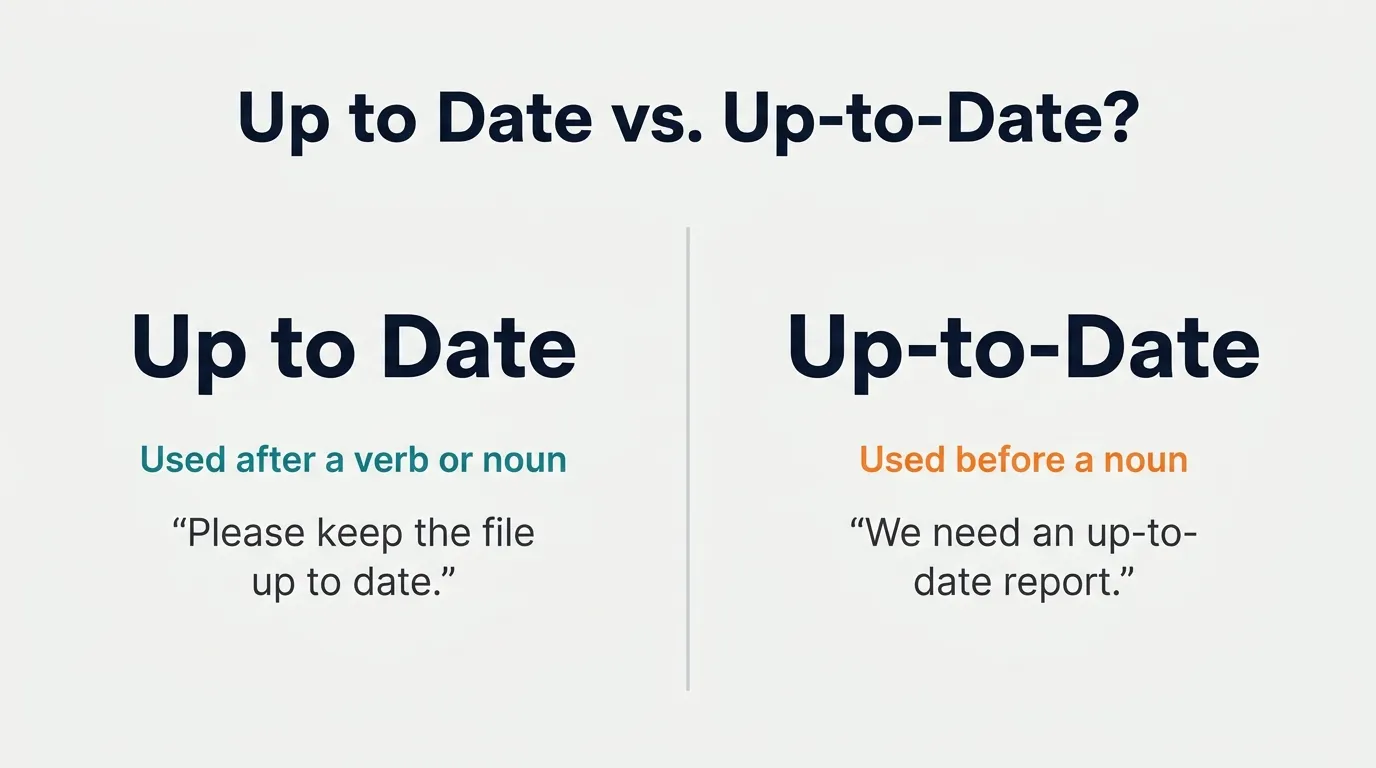
Use up-to-date with hyphens before a noun, as in “an up-to-date list.” Use up to date without hyphens after a verb, as in “the list is up to date.” That’s the rule in a nutshell.
Why the difference? Before a noun, the three words team up as one adjective, so hyphens hold them together. After a verb, they work more loosely, so no hyphens are needed.
It’s a small detail, but readers notice it. This guide gives you the full rule, a quick test, plenty of examples, and the cases where style guides disagree. By the end, you’ll choose the right form without stopping to think.
Did You Know? 🔍
The habit of hyphenating a compound modifier before a noun, but not after it, goes back a long way. It has been part of Chicago style since the first edition of the manual in 1906.
Quick Answer
Write up-to-date with hyphens when it comes right before a noun: “up-to-date information.” Write up to date without hyphens when it comes after a verb or after the noun: “the information is up to date.” The words are the same. Only their job in the sentence changes.
⚡ Quick Rule in 1 Line
“Before a noun, hyphenate it; after a verb, let it breathe — up-to-date versus up to date.”
Up to Date or Up-to-Date: What’s the Difference?
The difference is grammar, not meaning. Up-to-date with hyphens is an adjective that sits before a noun. Up to date without hyphens usually follows a verb. Both mean “current” or “using the latest information.”
Think of it as one phrase wearing two outfits.
- Up-to-date (hyphenated) describes a noun. It means current or modern.
- Up to date (open) usually comes after a verb like is, keep, or bring. It tells you the state of something.
Notice that region doesn’t matter here. American, British, Canadian, and Australian writers all follow the same pattern. So you don’t need to worry about US vs UK English.
What does the phrase mean? It means containing the latest information, or being informed about recent news. A document can be up to date. A person can be, too.
Here’s the same idea used both ways:
- “This is an up-to-date map.” (describes the noun “map”)
- “This map is up to date.” (follows the verb “is”)
The Hyphen Rule Explained
When two or more words work together as one adjective before a noun, add hyphens. When the same words come after the noun or a linking verb, leave the hyphens out. This pattern is called the compound modifier rule.
A compound modifier is a group of words that describe a noun as a single idea. Grammar guides also call it a compound adjective or a phrasal adjective.
Here’s why hyphens help. Look at this pair:
- “We need an up-to-date report.” (one clear idea: a current report)
- “We need an up to date report.” (the reader has to pause and sort out the words)
The hyphens act like glue. They tell the reader, “Treat these three words as one.”
After a verb, no glue is needed. The sentence structure already makes the meaning clear. That’s why we write “The report is up to date.”
Several sources back this up. The Oxford English Dictionary, as quoted by Grammar Book, treats up to date as a phrase that gets hyphens before a noun and none after it. Australia’s government Style Manual uses the same contrast: “the up-to-date accounts,” but “the accounts are up to date.”
Up to Date vs Up-to-Date Comparison Table
This table puts both forms side by side. Check which position the phrase is in, and the right form follows. It works the same in American and British English.
| Feature | Up-to-date (hyphenated) | Up to date (open) |
|---|---|---|
| Where it appears | Before a noun | After a verb or after the noun |
| Job in the sentence | Adjective | Describes the state of something |
| Typical pattern | an up-to-date + noun | is / stays / keeps + up to date |
| Example | “an up-to-date schedule” | “The schedule is up to date.” |
| Example | “the most up-to-date data” | “Keep me up to date.” |
| Region | US, UK, and others | US, UK, and others |
If the phrase is touching a noun that comes after it, use hyphens. If it follows a verb, skip them.
The Two-Second Test
Here’s a fast check. Look at the word right after the phrase. If it’s a noun, add hyphens. If it’s not, leave them out. You can also try moving the phrase after the verb to see if it still sounds natural.
Step 1. Find the phrase. Step 2. Ask: “Is a noun right after it?” Step 3. If yes, use up-to-date. If no, use up to date.
Try it out:
- “Please send an ___ list.” → A noun (list) follows, so write up-to-date.
- “Please keep the list ___.” → No noun follows, so write up to date.
There’s a second trick. Rewrite the sentence so the phrase follows is.
- “an up-to-date policy” → “the policy is up to date.” ✅ That works.
If the rewrite sounds natural, you’ve found the open form.
Phrases That Follow the Same Rule
Many other multi-word phrases follow this same pattern. They get hyphens before a noun and stay open after a verb. Once you learn the rule for one, you can apply it to the others without looking each one up.
| Before a noun (hyphenated) | After a verb (open) |
|---|---|
| an up-to-date record | The record is up to date. |
| an out-of-date map | The map is out of date. |
| a well-known author | The author is well known. |
| an over-the-counter drug | The drug is sold over the counter. |
| a step-by-step guide | Follow the guide step by step. |
| a long-term plan | The plan works long term. |
Out of date is a perfect twin. The Chicago Manual of Style gives the example “feelings that were out of date” for the open form after a noun.
A few phrases don’t need hyphens even before a noun. Adverbs ending in -ly, like “a highly skilled worker,” are one example. Also, some phrases are always written open in dictionaries. So when you’re unsure, a quick dictionary check never hurts.
Memory Trick
A friendly trick: “Hyphens hug the noun.” When the phrase sits right next to a noun, hyphens hold it in place. When a verb sits between them, there’s no hugging needed.
Here’s another helpful link. You already know over-the-counter gets hyphens when it describes a noun, as in “an over-the-counter medicine.” Up-to-date works the same way. If you can remember one, you can remember the other.
Or try this picture:
- 🧩 Before a noun → the words are puzzle pieces locked together (hyphens).
- 🚶 After a verb → the words stroll along separately (spaces).
20 Example Sentences
Seeing the rule in action makes it stick. Below you’ll find sentences in three groups: hyphenated before a noun, open after a verb, and trickier cases. Read each aloud.
Hyphenated before a noun (up-to-date)
- I always check the up-to-date forecast before a hike.
- She keeps an up-to-date list of her passwords.
- The new edition has the most up-to-date information.
- We need up-to-date software for the project.
- His up-to-date records saved the team hours of work.
- Please share an up-to-date copy of your resume.
- Our guide gives up-to-date advice for new writers.
Open after a verb (up to date)
- The website is up to date.
- I’ll keep you up to date on the project.
- She brought her notes up to date last night.
- Is your passport up to date?
- They stay up to date by reading the news daily.
- Make sure your app is up to date before you travel.
- The files were up to date as of Monday.
Trickier cases
- Bring the team up to date, then share an up-to-date schedule. (both forms in one sentence)
- Her calendar is up to date, so send me the up-to-date version.
- The manual is up to date, and it includes up-to-date diagrams.
- We keep our up-to-date policies and our records up to date.
- Staying up to date takes time, but an up-to-date team performs better.
- Is this the most up-to-date report, or is it out of date?
Where Style Guides Differ
Most guides agree on the main rule: hyphenate before a noun. Small differences show up after a noun or verb. The Chicago Manual of Style leaves the phrase open there, while some dictionaries list the hyphenated form on its own.
This matters if you write for a publication with a set style.
Chicago Manual of Style. Chicago says to keep “up to date” open when it follows the noun. Its own example pair is “an up-to-date solution” but “his equipment was up to date.” Chicago also favors a light touch with hyphens after nouns.
Merriam-Webster. In one Chicago Q&A, a reader noted that Merriam-Webster appears to support hyphens in all positions. Chicago’s reply was to follow Chicago’s rule for Chicago-style work. I couldn’t confirm the exact dictionary entry wording, so check it yourself if the answer matters for your job.
Government and academic guides. Australia’s Style Manual shows the same before-and-after pattern as Chicago. So do many university style pages.
AP style. AP loosened some of its hyphen guidance in 2019. It now says a hyphen isn’t needed in a compound modifier if the phrase is commonly seen as one unit and the meaning is clear. I couldn’t confirm what AP says about up-to-date itself, so if you follow AP, check its current stylebook.
So what should you do? Follow the style guide your editor, school, or employer uses. If there’s no guide, use the standard rule from this article. It’s safe in nearly every setting.
Common Mistakes
Most mistakes come down to skipping the hyphens before a noun or adding them after a verb. A few writers also spell the phrase as one word. Here are the usual slip-ups and how to fix each.
Mistake 1: No hyphens before a noun
- ❌ “We need an up to date inventory.”
- ✅ “We need an up-to-date inventory.”
Mistake 2: Hyphens after a verb
- ❌ “The inventory is up-to-date.”
- ✅ “The inventory is up to date.”
Note: Many writers do hyphenate after a verb, and plenty of dictionaries list the hyphenated form. It isn’t a serious error. But the open form is the safer choice for most formal writing, and it matches Chicago style.
Mistake 3: Writing it as one word
- ❌ “Keep the page uptodate.”
- ✅ “Keep the page up to date.”
Mistake 4: Mixing up the phrase and the verb update
- ❌ “Please up-to-date the file.”
- ✅ “Please update the file.”
The Mistake 5: Hyphenating only part of it
- ❌ “an up-to date report”
- ✅ “an up-to-date report”
Mistake 6: Using underscores or spaced hyphens
- ❌ “up_to_date” or “up – to – date” (in regular writing)
- ✅ “up-to-date”
When to Use Each Form
Use up-to-date whenever the phrase comes before a noun. Use up to date after verbs like is, keep, stay, and bring. When your sentence feels awkward, consider rewording with current, latest, or updated.
Here’s your quick guide:
- Before a noun → up-to-date: “an up-to-date guide”
- After “is,” “are,” or “was” → up to date: “The guide is up to date.”
- After “keep,” “stay,” or “bring” → up to date: “Keep me up to date.”
- After a noun → up to date: “Her files, up to date as of today, are ready.”
- In a superlative before a noun → up-to-date: “the most up-to-date source”
And if the phrase feels clumsy, swap it for a simpler word:
- “the up-to-date report” → “the latest report”
- “keep me up to date” → “keep me informed”
- “an up-to-date list” → “a current list”
Simpler words can make your writing cleaner, too.
Expert Tip 💡
If you write a lot, set up a style sheet. List your choices for phrases like up to date, out of date, and well known. Then you won’t have to look them up again. Editors do this all the time, and it keeps long documents consistent. Also, use your word processor’s search tool to hunt for “up to date” and check each result’s position in the sentence.
Quick Quiz
Test yourself. Answers are at the bottom.
- Fill in the blank: “Please send me the most ___ numbers.” (up to date / up-to-date)
- Fill in the blank: “Is the calendar ___?” (up to date / up-to-date)
- Fix this sentence: “Keep me up-to-date on the news.”
Answers:
- up-to-date (it comes before the noun numbers).
- up to date (it follows the verb is).
- “Keep me up to date on the news.”
FAQs
1. Is it up to date or up-to-date?
Both can be right. Use up-to-date with hyphens before a noun and up to date without hyphens after a verb. The position in the sentence decides the form.
2. Is “up to date” hyphenated?
Only before a noun. In “an up-to-date list,” it’s hyphenated. In “the list is up to date,” it isn’t. That’s the standard rule in most style guides.
3. Is “up to date” one word, two words, or three?
It’s three separate words, with or without hyphens. Writing it as one word, “uptodate,” is wrong. Keep the spaces or the hyphens.
4. Do I hyphenate “up to date” after “is”?
Usually not. Chicago style says to leave it open after the noun or verb, as in “the equipment was up to date.” Some dictionaries list the hyphenated form, so check your style guide.
5. Is “keep up to date” hyphenated?
No. After a verb like keep, the phrase works like an adverb, so you write “keep up to date.” You’d only add hyphens if a noun followed it.
6. What does up to date mean?
It means current or containing the latest information. If your phone is up to date, it has the newest software. If you’re up to date, you know the latest news.
7. Is there a difference between US and UK English?
No. Both follow the same hyphen pattern. Hyphens go before a noun, and none go after. That makes this rule easier than spelling pairs like color and colour.
8. Is “out of date” hyphenated the same way?
Yes. It follows the same rule. Write “an out-of-date map” before a noun and “the map is out of date” after a verb.
9. What’s the difference between “up to date” and “updated”?
Updated is a verb form or adjective meaning something has been changed with new information. Up to date describes the current state. “The updated file is up to date” uses both.
10. Can I avoid the hyphen question completely?
Yes. Swap in current, latest, or recent. “An up-to-date report” becomes “a current report.” It’s shorter and avoids the rule.
Conclusion
So, up to date or up-to-date? The answer depends on where the phrase sits. Put hyphens in up-to-date when it comes right before a noun, like “an up-to-date list.” Leave them out in up to date when it follows a verb, like “the list is up to date.”
Remember the simple picture: hyphens hug the noun. If you’re unsure, run the two-second test. Look at the word after the phrase. A noun means hyphens.
Style guides differ a little after the noun, so follow your editor’s choice when there is one. Otherwise, the standard rule is safe. The same pattern also works for out of date, well known, and step by step.

Hi, I’m Daniel Carter. I’m passionate about helping learners improve their English with practical grammar tips and clear writing advice.