You’re writing a thank-you note to a coworker. You type, “You’ve been a great alley this year.” Then you pause. A great narrow lane? That doesn’t sound right.
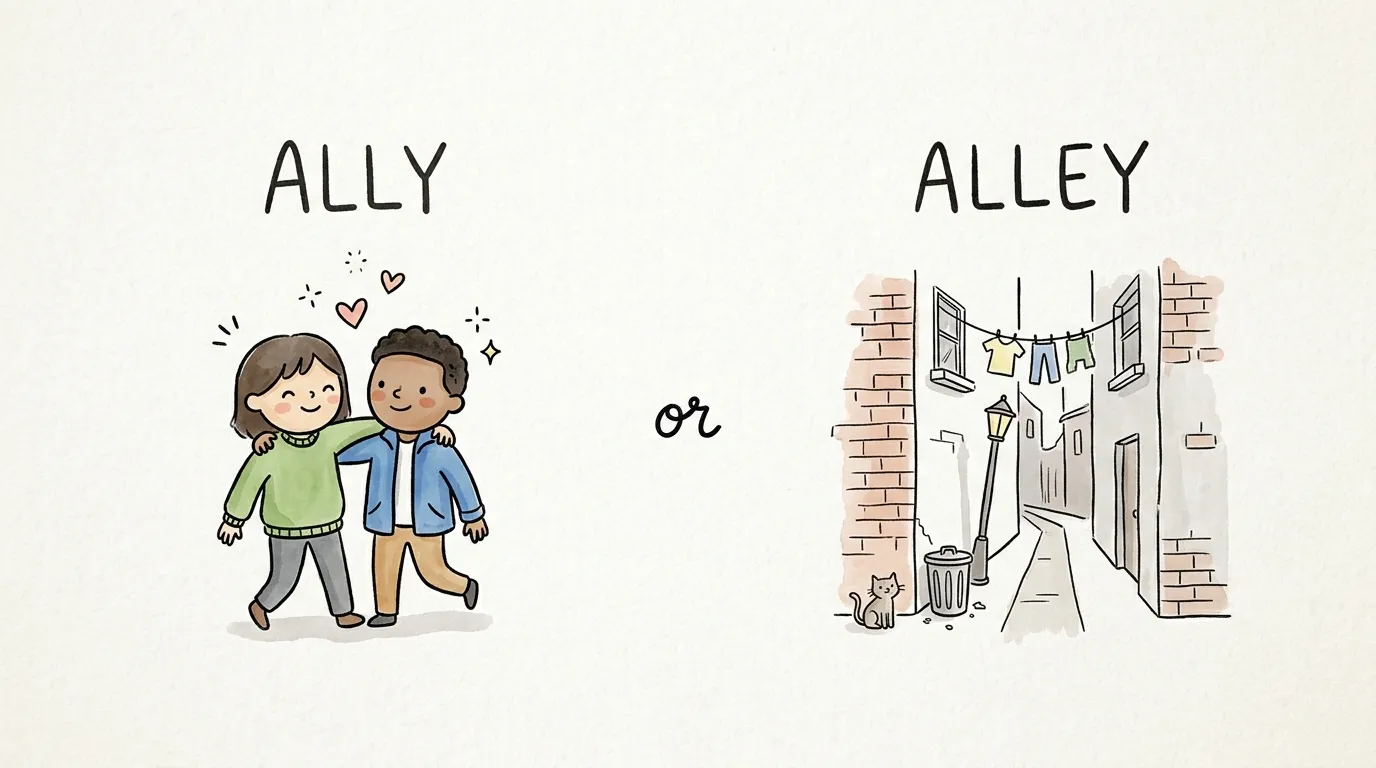
An ally is a friend, partner or supporter. An alley is a narrow lane between buildings. If you mean a person or group that helps you, write ally. If you mean a passage behind a building, write alley.
These two words look alike, and plenty of people mix them up. They don’t sound exactly the same, though. And their plurals take different endings, which gives you a quick test.
This guide explains both words in simple terms. You’ll see examples, a comparison table, a memory trick, and a short quiz. By the end, you’ll pick the right word without stopping to think.
Table of Contents
- Did You Know?
- Quick Answer
- Quick Rule in 1 Line
- Ally or Alley: The Core Difference
- Are Ally and Alley Homophones?
- Ally vs Alley Comparison Table
- The Plural Test: Allies vs Alleys
- Ally as a Verb
- Common Phrases With Ally and Alley
- Memory Trick
- 18 Example Sentences
- Common Mistakes
- When to Use Each Word
- Expert Tip
- Quick Quiz
- FAQs
- Conclusion and Key Takeaways
Did You Know? 🔍
These two words come from very different roots. According to Merriam-Webster, ally comes from a Latin word meaning “to bind to.” It’s related to the word ligament. Alley comes from an old French word for “a going,” from a verb meaning “to go.” So an ally binds, and an alley lets you go through.
Quick Answer Box
An ally is a person, group or country that supports another. An alley is a narrow street or passage between buildings. Ally has a Y and an eye sound at the end. Alley has an E and a Y and ends in ee. The plural of ally is allies; the plural of alley is alleys.
⚡ Quick Rule in 1 Line
An ally helps you; an alley is a lane you walk through.
Ally or Alley: The Core Difference
An ally is someone who supports you or works with you toward a shared goal. An alley is a narrow path between buildings. One word describes a relationship. The other describes a place you can walk or drive through.
Here’s how Merriam-Webster treats each word.
Ally (noun):
- A country or state joined to another by treaty or league
- A person or group joined with another for a common purpose
- When capitalized in “the Allies,” the nations that fought together in World War I or World War II
Alley (noun):
- A narrow street, especially one behind or between buildings
- A lane for bowling
- An older sense: a garden or park walk lined with trees or bushes
Notice the difference in meaning. An ally is about people. An alley is about places. If you can replace the word with “friend” or “supporter,” you want ally. If you can replace it with “lane” or “passage,” you want alley.
Try it on the opening example. “You’ve been a great ___ this year.” Swap in “supporter,” and the sentence works. So it’s ally.
Are Ally and Alley Homophones?
Not exactly. Many websites call them homophones, but their endings sound different. The noun ally usually ends with an “eye” sound, like AL-eye. Alley ends with an “ee” sound, like AL-ee. They’re close, but your ear can tell them apart.
That’s a helpful fact for ESL learners. When you say the words slowly, you can hear the difference. Grammarist describes them as words that are “close in spelling and pronunciation,” which is a fair way to put it.
Here’s the thing, though. The verb ally is often said a little differently. It can be stressed on the second syllable, like uh-LYE. That’s normal for many English words that change stress between a noun and a verb.
Here’s a simple summary:
- Alley: AL-ee (rhymes with “valley”)
- Ally (noun): AL-eye
- Ally (verb): often uh-LYE, or AL-eye
The takeaway? Don’t rely on sound alone. Check the meaning, and use the plural test below.
Ally vs Alley Comparison Table
This table puts the two words side by side. Use it as a quick checklist when you’re editing. Look at the plural row in particular, because it’s the fastest way to catch a mix-up.
| Feature | Ally | Alley |
|---|---|---|
| Main meaning | A supporter, partner or friendly country | A narrow street or passage |
| Part of speech | Noun and verb | Noun |
| Ending sound (noun) | “eye” (AL-eye) | “ee” (AL-ee) |
| Plural | Allies | Alleys |
| Past tense / form | Allied | Not applicable |
| Example | She is a loyal ally. | They walked down the alley. |
| Related idea | Alliance, allied | Lane, passage, backstreet |
| Word origin | Latin, “to bind to” | Old French, from a verb “to go” |
The Plural Test: Allies vs Alleys
Here’s the best shortcut. The plural of ally is allies, with an “ies” ending. The plural of alley is alleys, with a plain “s.” If the plural you want ends in “ies,” you’re dealing with ally.
Why does this happen? English has a spelling rule. When a word ends in a consonant plus Y, you change the Y to “ies” in the plural. Ally ends in L plus Y. So it becomes allies.
When a word ends in a vowel plus Y, you just add S. Alley ends in E plus Y. So it becomes alleys.
Compare these pairs:
| Singular | Plural | Why |
|---|---|---|
| ally | allies | consonant + y → ies |
| alley | alleys | vowel + y → ys |
| city | cities | consonant + y → ies |
| key | keys | vowel + y → ys |
So if you ever wonder which word fits, try making it plural. “The allies” feels right for friends. “The alleys” feels right for lanes. It’s a quick test that works almost every time.
Ally as a Verb
Ally can also be a verb. It means to unite or join with someone for a shared purpose. Its past tense is allied, and its present participle is allying. Alley has no verb form in everyday English, so a verb use points to ally.
Here are verb examples:
- The two companies allied to launch a new product.
- She chose to ally herself with the new team.
- The groups are allying against the proposal.
Merriam-Webster gives a similar example about people who “allied himself with a wealthy family by marriage.” The idea is the same. Two sides join together.
This gives you another easy test. Can you put “-ed” or “-ing” on the word and have it still mean something? Allied and allying make sense. “Alleyed” doesn’t. So if you need an action word, you need ally.
One more related word: allay. It’s a verb meaning to calm or ease, as in “allay fears.” It sounds like a third cousin of ally and alley. If you’re writing about easing a worry, you want allay. This article is about ally and alley, but it helps to know the third look-alike exists.
Common Phrases With Ally and Alley
Many everyday phrases use these words. Learning them in chunks makes the right spelling stick. Here are the most common ones.
Phrases with ally:
- A close ally
- A political ally
- An ally in the fight
- Allied forces
- Allied health workers
- “The Allies” (capitalized, for World War I and II nations)
Phrases with alley:
- A back alley
- A bowling alley
- A blind alley (a dead end)
- Tornado Alley (a region name)
- An alley cat
- Right up my alley
The idiom “up my alley” deserves a note. Merriam-Webster defines “up one’s alley” as something suited to your tastes or abilities. It lists “down one’s alley” as a less common version. So “This job is right up her alley” means the job fits her skills.
People sometimes write “up my ally,” which is wrong. The idiom is about a place or lane, like a bowling alley where you feel at home. Always use alley there.
Memory Trick
Here’s an easy one: ALLY ends in a Y, and a Y looks like two arms joined together. Picture two people linking arms. That’s an ally.
Try a second trick for alley. Look at the double L in the middle. The two L’s look like two tall walls, and the lane runs between them. Alley also has an E, like the E in “street.”
One more tip. Ask yourself: can I turn this word into “allies”? Allies means more than one friend or partner. If that fits your sentence, you want ally. If the sentence needs a lane, it’s alley.
18 Example Sentences
Read these aloud to hear the difference. Then notice the clue in each sentence. Words like “supports,” “helps” and “friend” point to ally. Words like “walked,” “behind” and “narrow” point to alley.
Ally (noun):
- She has been a loyal ally to our team all year.
- The two countries became allies after the treaty.
- He found an unlikely ally in his new manager.
- Parents can be strong allies for students with learning needs.
- The company welcomed several allies to the launch.
- Teachers are the best allies a new student can have.
Ally (verb):
- The two clubs plan to ally with the city.
- They allied themselves with the local library.
- The groups are allying to raise money for repairs.
- Several nurses allied to ask for better schedules.
Alley (noun):
- We walked down the alley behind the restaurant.
- The kids played ball in the quiet alley.
- A cat slipped into the dark alley.
- The garbage truck comes down the alley on Tuesdays.
- They bowled three games at the bowling alley.
- This kind of puzzle is right up my alley.
Side by side:
- My ally met me in the alley behind the bakery.
- The allies rented a store near the alleys of the old town.
Common Mistakes
These errors show up in emails, essays and social posts. Each pair shows the mistake, then the fix. Scan your draft for them before you publish.
❌ You’ve been such a great alley to me. ✅ You’ve been such a great ally to me.
❌ We walked through a narrow ally. ✅ We walked through a narrow alley.
The two countries are alleys. ✅ The two countries are allies.
❌ That’s right up my ally. ✅ That’s right up my alley.
❌ The bowling ally closes at midnight. ✅ The bowling alley closes at midnight.
They alleyed with the other team. ✅ They allied with the other team.
The most common slip is writing alley when you mean a supporter. It’s easy to do, because both words begin with “all.” Slow down on that middle part.
When to Use Each Word
Use ally when you’re talking about support, partnership or teamwork. Use alley when you’re talking about a physical lane, path or bowling lane. If you need a verb, it’s always ally.
Here’s a quick decision guide:
- Talking about a person or group that helps? Ally.
- Talking about countries on the same side? Allies.
- Describing a lane behind buildings? Alley.
- Describing a place to bowl? Alley.
- Using the idiom “up my ___”? Alley.
- Need a verb for joining forces? Ally.
- Need the plural? Allies or alleys. Match the ending.
Expert Tip 💡
When you proofread, search your document for “alley” and “ally” separately. Read each sentence and ask, “Is this a person or a place?” This takes under a minute and catches the mix-up every time. Spell-checkers can’t help, because both are real words.
Quick Quiz
Try these three questions. The answers are at the bottom.
- Which word fits? “The mayor needs an ___ on the council.”
- Which word fits? “The shop is in a narrow ___ behind Main Street.”
- What’s the plural of ally?
Answers: 1) ally. 2) alley. 3) allies.
FAQs
What is the difference between ally and alley?
An ally is a person, group or country that supports another. An alley is a narrow lane between buildings. One word is about people and teamwork. The other is about a place.
Are ally and alley homophones?
Not exactly. They’re close in spelling and sound, but the noun ally ends with an “eye” sound and alley ends with an “ee” sound. Many websites still call them homophones, so you may see that label.
What is the plural of ally?
The plural is allies. Ally ends in a consonant plus Y, so the Y changes to “ies.” This is the quickest way to tell it apart from alley.
What is the plural of alley?
The plural is alleys. Alley ends in a vowel plus Y, so you simply add S.
Can ally be a verb?
Yes. To ally means to join or unite with someone for a shared purpose. The forms are ally, allies, allied and allying.
Is it “up my alley” or “up my ally”?
It’s “up my alley.” Merriam-Webster defines “up one’s alley” as something suited to your tastes or abilities. Never use ally in that phrase.
What does allied mean?
Allied is the past tense of the verb ally. It also works as an adjective, as in “allied forces” or “allied health professionals.”
What is the difference between ally and allay?
Allay is a verb meaning to calm or ease, as in “allay fears.” Ally means to join with someone or a supporter. They look and sound similar, but they aren’t related in meaning.
Where does the word alley come from?
According to Merriam-Webster, it comes from Middle English, from an Anglo-French word, from a verb meaning “to go.” Its first known use is in the 14th century.
Where does the word ally come from?
Merriam-Webster traces it to Middle English, from Anglo-French, from Latin alligare, “to bind to.” It shares roots with words like ligament.
Conclusion
Here’s the final answer. Use ally for a supporter, partner or friendly nation. Use alley for a narrow lane between buildings. Remember that one is about people and the other is about places.
When you’re unsure, try the plural test. Allies ends in “ies.” Alleys ends in a plain “s.” That simple check solves most mix-ups in seconds.
Also remember the idiom. It’s always “up my alley,” never “up my ally.” And if you need a verb, ally is your word.
So the next time you thank a coworker for their help, write it with confidence: “You’ve been a great ally this year.” Short, clear and correct.

Hi, I’m Daniel Carter. I’m passionate about helping learners improve their English with practical grammar tips and clear writing advice.