You’re about to post a teaser for your new video. You type, “Here’s a sneak peak!” Then your friend texts you, “Did you mean peek?” Oops.
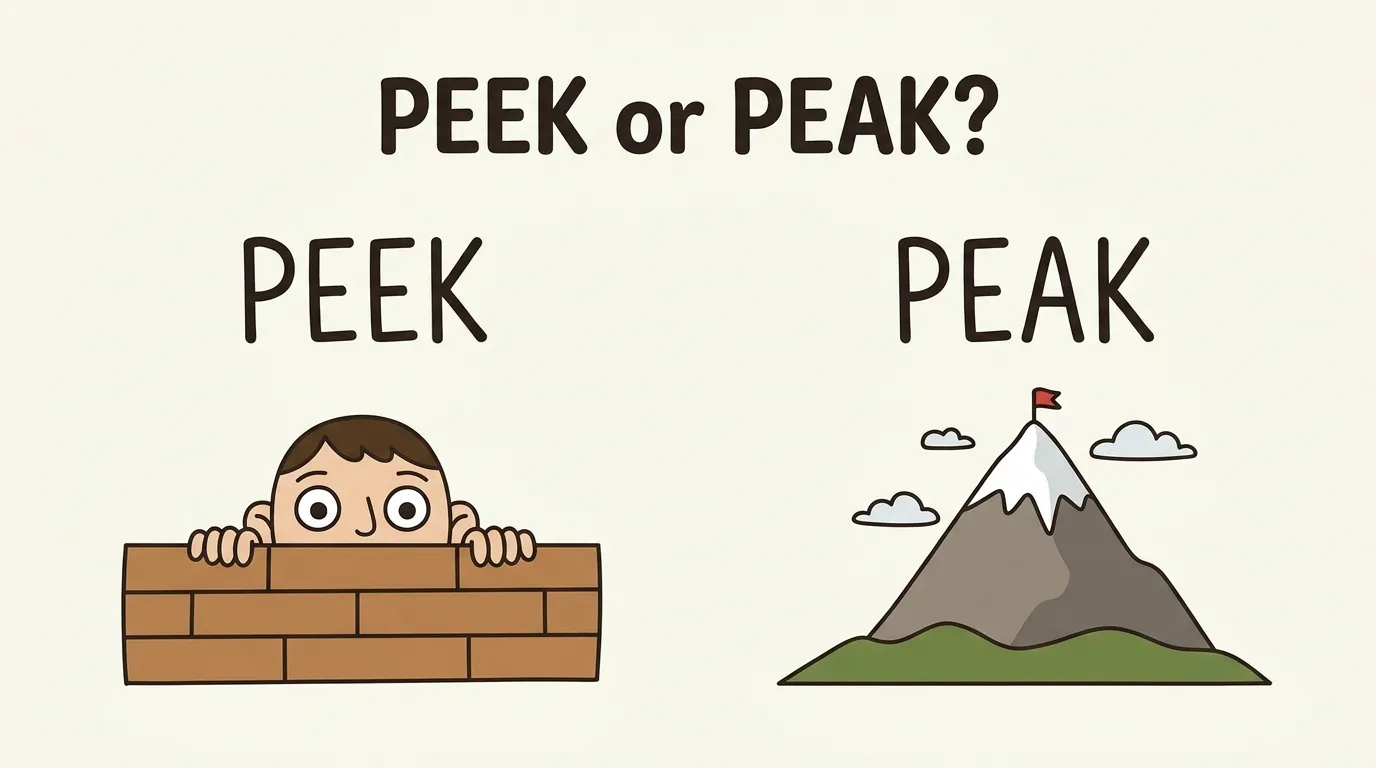
Peek means a quick look. Peak means the highest point. A “sneak peek” is a quick, early look, so it’s always peek. A mountain top is always peak.
These two words sound exactly the same, which is why they trip people up. There’s even a third look-alike, pique, that means to spark interest. The three words share one sound but have three jobs.
This guide breaks it down in plain English. You’ll get examples, a comparison table, memory tricks and a quick quiz. By the end, you’ll know which one to type without a second thought.
Table of Contents
- Did You Know?
- Quick Answer
- Quick Rule in 1 Line
- Peek or Peak: The Core Difference
- Why “Sneak Peek” Is Always Peek
- Peek vs Peak vs Pique Comparison Table
- Where Pique Fits In
- Grammar: Verb, Noun and Adjective Forms
- Common Phrases
- Memory Trick
- 20 Example Sentences
- Common Mistakes
- When to Use Each Word
- Expert Tip
- Quick Quiz
- FAQs
- Conclusion and Key Takeaways
Did You Know? 🔍
Pique comes from a French verb that means “to prick.” According to Merriam-Webster, its earliest English use was as a noun, and the first known use is from 1551. So when something piques your curiosity, it gives it a little prick, like a nudge.
Quick Answer Box
Peek means to take a quick look: “She peeked inside the box.” Peak means the highest point: “the peak of the mountain.” A “sneak peek” always uses peek. If you mean to spark interest, use a third word, pique: “That title piqued my curiosity.”
⚡ Quick Rule in 1 Line
The Peek is a quick look; peak is the top; pique sparks your interest.
Peek or Peak: The Core Difference
Peek is about looking. Peak is about reaching the top. Peek is a verb or a noun meaning a quick glance. Peak is a noun, verb or adjective meaning the highest point or level of something.
Here’s a closer look at each word.
Peek
- Verb: to look quickly or sneakily (“He peeked through the window.”)
- Noun: a quick look (“Take a peek at this.”)
Peak
- Noun: the highest point (“the mountain peak”)
- Verb: to reach the highest point (“Sales peaked in June.”)
- Adjective: at the highest level (“peak season”)
Dictionary.com says peek is most commonly a verb meaning to look at something quickly or sneakily, and a noun for that kind of look. That’s the core idea. Peek is about eyes.
Peak, on the other hand, is about height or the best moment. A runner can reach peak fitness. Traffic can hit peak hours. A mountain has a peak.
A simple test helps. Ask yourself, “Am I talking about a look, or about a top?” If it’s a look, use peek. If it’s a top or a high point, use peak.
Why “Sneak Peek” Is Always Peek
“Sneak peek” is always spelled with two E’s. A sneak peek is a quick, early look at something, like a movie trailer or a product preview. It has nothing to do with height, so the spelling with “ea” doesn’t fit.
This is the single most common error with these words. People type “sneak peak” because the “ea” form feels familiar. A mountain shape would not be sneaky, as one language blog jokes. A sneaky look, however, makes perfect sense.
Here’s the logic in three steps:
- A sneak peek is a look.
- A look uses peek.
- So the phrase is “sneak peek.”
You’ll see the same mistake in related phrases:
- ❌ Take a peak at this.
- ✅ Take a peek at this.
- ❌ Here’s a sneak peak of the new design.
- ✅ Here’s a sneak peek of the new design.
If you work in marketing or social media, double-check this phrase before every launch. It’s a small error that readers notice fast.
Peek vs Peak vs Pique Comparison Table
This table shows all three words side by side. Use it as a quick checklist. Notice that all three sound alike, so only the spelling and the meaning tell them apart.
| Word | Meaning | Part of speech | Example |
|---|---|---|---|
| Peek | A quick or sneaky look | Verb, noun | She took a peek at the gifts. |
| Peak | The highest point or level | Noun, verb, adjective | The runner reached her peak. |
| Pique | To spark interest, or to irritate; also a feeling of resentment | Verb, noun | The title piqued my curiosity. |
Now see how the forms change:
| Base word | Past tense | -ing form |
|---|---|---|
| peek | peeked | peeking |
| peak | peaked | peaking |
| pique | piqued | piquing |
Look at the past tense row. “Peeked at the cake,” “peaked in June” and “piqued my interest” all sound identical. Only the spelling tells you what you mean.
Where Pique Fits In
Pique is a verb that means to spark or arouse a feeling, usually interest or curiosity. It can also mean to irritate. As a noun, it means a flash of resentment, as in “a fit of pique.” It’s the least common of the three words.
Merriam-Webster lists the main meaning as to excite or arouse, especially by a provocation or challenge. Its second meaning is to arouse anger or resentment. The noun, as in “a fit of pique,” means a brief feeling of wounded pride.
This is where a famous mistake lives:
- ❌ The mystery peaked my curiosity.
- ✅ The mystery piqued my curiosity.
“Peaked my interest” shows up everywhere online. It feels right because the sound matches. But your interest doesn’t climb a mountain. It gets sparked, so you need pique.
Two memory hooks help here:
- Dictionary.com suggests focusing on the Q in pique.
- Things that pique your interest are often unique, and “unique” has the same “que” sound.
Pique is a good example of why English looks “unfamiliar” to learners. Merriam-Webster points out that we know the “ique” spelling from words like technique, antique and unique. Pique comes from French, so it keeps the French look.
Grammar: Verb, Noun and Adjective Forms
Peek works as a verb and a noun. Peak works as a noun, verb and adjective. Pique works as a verb and a noun. Knowing the job each word does in a sentence is the fastest way to spot a mistake.
Here’s how each word behaves.
Peek
- “She peeks around the corner.” (verb)
- “I took a quick peek.” (noun)
- It’s rarely used as an adjective.
Peak
- “Traffic peaks at 5 p.m.” (verb)
- “The peak was covered in snow.” (noun)
- “We visited during peak season.” (adjective)
Pique
- “That headline will pique your interest.” (verb)
- “He left in a fit of pique.” (noun)
Here’s a handy grammar clue. If you see the word “season,” “hours,” “time” or “performance” after it, you almost always need peak. Those are peak partners. If you see “at,” “inside,” “through” or “around” after it, you probably need peek.
One more clue. If the word is paired with “interest,” “curiosity” or “attention,” you need pique. Those words are the natural partners of pique.
Common Phrases
Learning phrases in chunks makes spelling stick. Here are the most common ones, grouped by word. If you memorize the phrase, you’ll pick the right word almost without thinking.
Phrases with peek:
- Sneak peek
- Take a peek
- Peek inside
- Peek through the window
- Peekaboo
- Peek around the corner
Phrases with peak:
- Peak hours
- Peak season
- Peak performance
- Reach the peak
- Mountain peak
- Peak condition
The Phrases with pique:
- Pique your interest
- Pique your curiosity
- A fit of pique
- Piqued attention
- Piquing his interest
Notice a pattern. Peek phrases involve eyes. Peak phrases involve highs. Pique phrases involve minds and feelings.
Memory Trick
Dictionary.com shares a clever trick: peek has two E’s, just like “look” has two O’s. Two letters in a row, two eyes looking. That’s your peek.
For peak, think of the “A.” Writer’s Digest points out that the “A” in peak looks a bit like a mountain peak. Picture the capital A as the pointed top of a mountain. That’s your peak.
For pique, remember the Q. The strange Q in the middle matches the strange, curious things that pique your interest. Or link it to “unique,” which has the same ending.
Here’s the trio in a single sentence from Dictionary.com:
The strange mountain peak on the cover was meant to pique your curiosity, and it worked, so you picked up the magazine to peek inside.
Read that line out loud a few times. It uses all three words correctly. It’s also a handy way to lock them in your mind.
20 Example Sentences
Read these aloud and notice the clue in each one. Words like “look,” “glance” and “through” point to peek. Words like “top,” “highest” and “season” point to peak. The Words like “interest” and “curiosity” point to pique.
Peek (look):
- She peeked through the curtains to see who was there.
- Take a peek at the new menu before you order.
- The kids tried to peek at their birthday gifts.
- The studio shared a sneak peek of the trailer.
- He gave the box a quick peek and closed it.
- I’ll peek inside the oven to check the bread.
Peak (highest point):
- The hikers reached the peak just before sunrise.
- Ice cream sales peak in July.
- She was at her peak as a swimmer last year.
- Avoid the highway during peak hours.
- Fall is peak season for visitors here.
- His career peaked in his thirties.
- The mountain peak was hidden by clouds.
Pique (spark interest):
- The strange title piqued my curiosity.
- A good headline should pique a reader’s interest.
- Her comment piqued his attention.
- He walked out in a fit of pique.
All three together:
- The photo of the peak piqued my interest, so I took a peek at the article.
- If a headline piques your curiosity, you might peek at the first lines before it peaks on social media.
- We climbed to the peak, then peeked over the edge, and the view piqued our wish to come back.
Common Mistakes
These errors show up in captions, emails and blog posts. Each pair shows the mistake, then the fix. Scan your draft for them before you publish.
❌ Take a peak at this recipe. ✅ Take a peek at this recipe.
❌ Here’s a sneak peak of the game. ✅ Here’s a sneak peek of the game.
The hikers reached the peek of the mountain. ✅ The hikers reached the peak of the mountain.
❌ We shop during peek hours. ✅ We shop during peak hours.
❌ The story peaked my curiosity. ✅ The story piqued my curiosity.
She hit her pique as a swimmer. ✅ She hit her peak as a swimmer.
The most common slip is “sneak peak.” The second is “peaked my interest.” If you only remember two things from this article, remember those.
When to Use Each Word
Use peek when someone is looking. The Use peak when you mean the top or the best level. Use pique when something sparks curiosity or irritation. When the sentence has two or three of these ideas, check each word on its own.
Here’s a short decision guide:
- Quick look or sneaky look? Peek.
- Highest point of a mountain? Peak.
- Busiest time or best level? Peak.
- Something makes you curious? Pique.
- A brief feeling of hurt pride? Pique.
- Early preview, like a trailer? Sneak peek.
- Reached the maximum? Peaked.
Expert Tip 💡
When you proofread, search your document for “peak” and “peek” separately. For each one, ask: “Is this a look, or a top?” It takes a minute, and spell-checkers can’t catch it because both are real words. Do the same for “peaked” and “piqued” when the sentence mentions interest or curiosity.
Quick Quiz
Try these three questions. The answers are at the bottom.
- Which word fits? “Here’s a sneak ___ at our new logo.”
- Which word fits? “Traffic is worst at ___ hours.”
- Which word fits? “That odd noise ___ my curiosity.”
Answers: 1) peek. 2) peak. 3) piqued.
FAQs
What is the difference between peek and peak?
Peek means to take a quick look. Peak means the highest point or level. They sound the same but have different meanings and different spellings.
Is it “sneak peek” or “sneak peak”?
It’s “sneak peek.” A sneak peek is an early look at something, and peek is the word for a look.
What does peek mean?
Peek is a verb that means to look quickly or secretly. It’s also a noun for such a look, as in “take a peek.”
What does peak mean?
Peak means the highest point or the top of something. It can also mean the maximum level, as in peak performance, or the verb “to reach a high point.”
What does pique mean?
Pique means to spark or arouse a feeling, usually interest or curiosity. It can also mean to irritate. As a noun, it means a brief feeling of hurt pride.
Is it “piqued my interest” or “peaked my interest”?
It’s “piqued my interest.” Pique means to arouse. “Peaked” would mean reached the top, which doesn’t fit here.
Are peek, peak and pique homophones?
Yes. All three share one pronunciation, though they have different spellings and meanings.
How do I remember the difference between peek and peak?
Peek has two E’s, like “look” has two O’s. Peak has an A that looks like a mountain top. These two tricks work well together.
What is the past tense of peek?
The past tense is peeked, and the -ing form is peeking. For peak, the forms are peaked and peaking.
Where does the word peek come from?
According to Dictionary.com, peek was first recorded in 1325–75 as Middle English piken. It may be a variant of kiken, “to look furtively.”
Conclusion
Here’s the final answer. Use peek for a quick look and peak for the highest point. If something sparks curiosity, use the third word, pique.
Remember the headline mistake. It’s “sneak peek,” never “sneak peak.” And it’s “piqued my interest,” not “peaked my interest.”
Use the memory tricks when you’re in a hurry. Two E’s in peek, like two O’s in look. An A in peak, like a mountain top. A Q in pique, like something unique.
So the next time you post a teaser, you’ll type it right the first time: “Here’s a sneak peek!” Short, clear and correct.

Hi, I’m Olivia Harper. I love turning complex English grammar into simple, practical lessons that help readers write and speak with confidence.