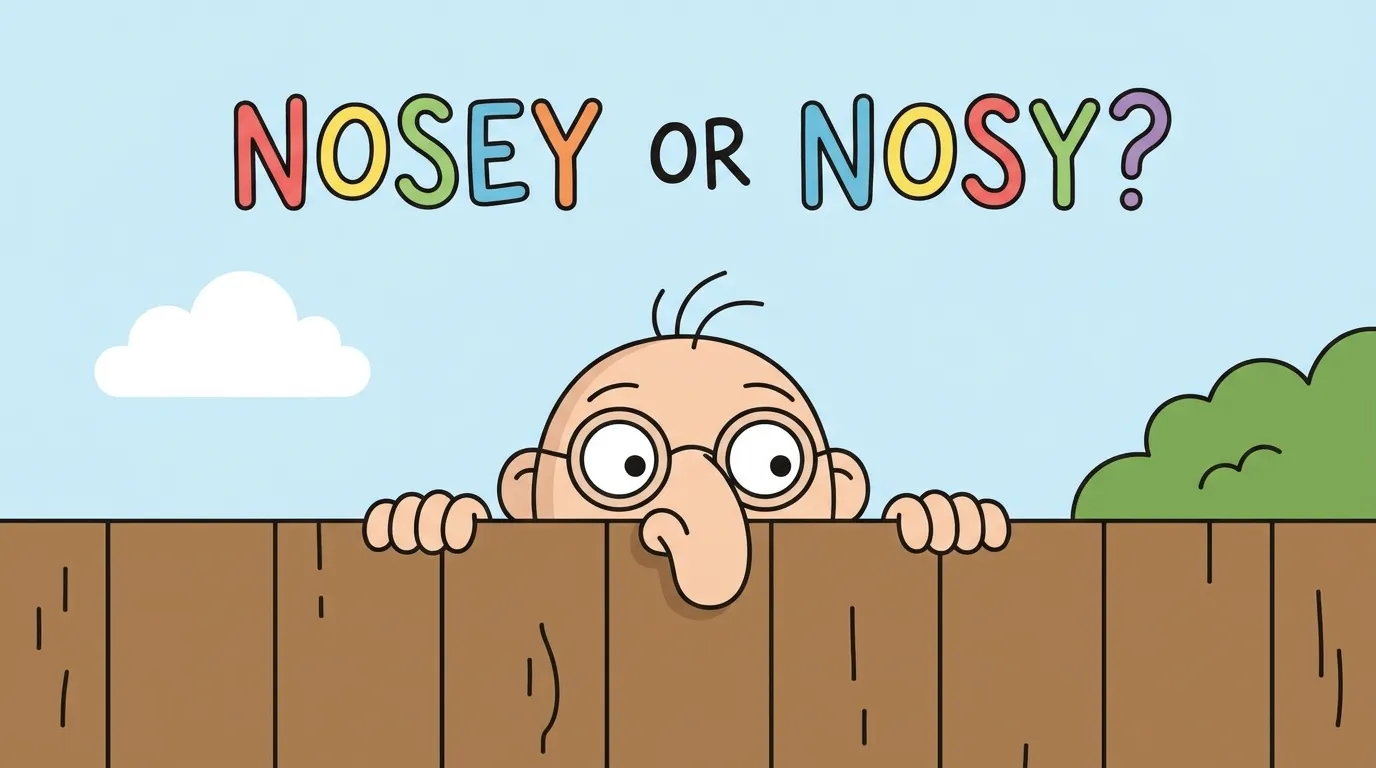
You type “nosey neighbor” in an email, and doubt hits. Nosy is the standard spelling; nosey is an accepted variant with the same meaning.
Merriam-Webster and Dictionary.com list nosy as the main spelling. Oxford Learner’s Dictionaries lists nosey first, with nosy as the alternative.
So neither spelling is “wrong.” But for school, work, or publishing, nosy is the safest choice.
Nosey tends to show up in casual texts and social posts. Nosy is far more common in published writing.
Many people think it’s a simple US versus UK split, like color and colour. It isn’t quite that clean.
This guide shows what the dictionaries really say, when each spelling fits, and how to remember it.
Did You Know? 🔍
Merriam-Webster dates the first known use of nosy to 1828. The word is built from nose plus the ending -y, which is why the spelling question exists at all.
Quick Answer
Nosy is the standard spelling and the safest choice in any writing. Nosey is an accepted variant that means the same thing: too curious about other people’s business. Major dictionaries recognize both, but nosy is far more common.
⚡ Quick Rule in 1 Line
Drop the silent e from nose before -y: nosy is standard, and nosey is just a variant.
What Does Nosy Mean?
Nosy describes a person who is too curious about other people’s private affairs. Merriam-Webster defines it as “of a prying or inquisitive disposition,” and it usually carries a mildly negative tone.
Think of the neighbor who watches every car that pulls into your driveway. Or the coworker who reads your screen as they walk past. That’s the kind of curiosity this word describes.
Oxford Learner’s Dictionaries labels the word informal and disapproving. In other words, calling someone nosy isn’t a compliment. It’s a gentle (or not so gentle) complaint.
Close synonyms include prying, snoopy, meddlesome, and intrusive. The word inquisitive is softer. It can describe healthy curiosity, while nosy almost always points at a boundary being crossed.
Nosey vs Nosy: The Real Difference
There is no difference in meaning or pronunciation. Both are said NOH-zee. The only difference is spelling preference, and the dictionaries don’t agree on which one comes first.
Here’s what the major sources show:
- Merriam-Webster: nosy is the main entry, with nosey listed as a variant.
- Dictionary.com: nosy is the main entry, “or nosey.” It calls nosey a much less common spelling.
- Oxford Learner’s Dictionaries: the headword is nosey, marked “(also nosy).”
So where does the “nosey is British” idea come from? Some usage guides say the British spelling is nosey and the American spelling is nosy. That’s a fair pattern to notice.
But the dictionaries don’t back a strict rule. Dictionary.com’s British entry even calls nosey “a variant spelling of nosy.” I couldn’t find a major source that treats nosy as wrong in British English.
That’s the exception to the usual US/UK template. With color and colour, each country has its own spelling. With nosy and nosey, one spelling simply wins everywhere, and the other is a side option.
Comparison Table
| Feature | Nosy | Nosey |
|---|---|---|
| Status | Standard spelling | Accepted variant |
| Meaning | Too curious about others’ affairs | Same |
| Pronunciation | NOH-zee | NOH-zee |
| Merriam-Webster | Main entry | Listed as variant |
| Dictionary.com | Main entry | “Or nosey,” much less common |
| Oxford Learner’s | Listed as “also” | Headword |
| Best for | Formal, academic, business, publishing | Casual texts, informal British writing |
| Comparative | nosier | nosier (not “noseyer”) |
| Superlative | nosiest | nosiest |
| Safe for US readers | Yes | Yes, but less common |
The Grammar Rule Behind the Spelling
English usually drops a silent e before adding -y. Nose becomes nosy, just like smoke becomes smoky and bone becomes bony. Keeping the e (nosey) breaks that pattern, which is why it’s the minority form.
Here are more words that follow the same rule:
- nose → nosy
- smoke → smoky
- bone → bony
- rose → rosy
- shade → shady
- ice → icy
A few -y words allow both forms, such as cagey and cagy. That’s why nosey doesn’t look strange to many readers. But when a dictionary has to pick one, the pattern favors nosy.
Wiktionary traces the word to nose plus -y. That simple build is why nosy feels logical once you see it.
Nosy Forms
Whichever spelling you pick for the base word, the other forms drop the e. The comparative is nosier, the superlative is nosiest, the adverb is nosily, and the noun is nosiness.
Merriam-Webster lists nosier and nosiest for both nosy and nosey. So even people who write “nosey” switch to an i when the word changes shape.
| Form | Word | Example |
|---|---|---|
| Adjective | nosy / nosey | She’s a nosy neighbor. |
| Comparative | nosier | My aunt is nosier than my mom. |
| Superlative | nosiest | He’s the nosiest kid in class. |
| Adverb | nosily | He nosily read the mail. |
| Noun | nosiness | Her nosiness annoyed everyone. |
Avoid “noseyer” and “noseyest.” They look like they follow the rule, but dictionaries don’t list them.
Memory Trick
Picture your nose. It already has one e in it, and that’s plenty. When nose gets its -y, the e steps aside, so you get nosy.
Here’s a second trick. Think of N-O-S-Y as “No Spare Y… I mean, no spare E.” Silly, yes. But silly sticks.
Or use the pattern: if you’d write smoky and rosy, you’d write nosy.
Example Sentences
Real examples help you see both spellings in action. Notice that the meaning never changes. Only the spelling does.
Standard spelling (nosy), everyday use
- My nosy neighbor knows every delivery that arrives on our street.
- Don’t be so nosy. It’s none of your business.
- The nosy coworker leaned over to read my screen.
- Nosy reporters waited outside the courthouse.
- She kept her wedding plans quiet to avoid nosy relatives.
- A nosy raccoon dug through the trash again last night.
Formal or professional use (nosy)
- The privacy policy protects users from nosy third-party apps.
- The article explains how nosy household gadgets collect data.
- A nosy manager can damage trust on a team.
- The novel’s nosy landlady drives the plot forward.
Informal or British-leaning use (nosey)
- I don’t mean to be nosey, but where did you get that coat?
- She gave me a nosey look across the table.
- Stop being so nosey, and mind your own business!
- Our nosey cat inspects every shopping bag.
Other word forms
- My brother is nosier than I am.
- She’s the nosiest person in the office.
- He nosily flipped through my notebook.
- Her nosiness made it hard to keep secrets.
Common Mistakes
Most nosy errors come from three places: wrong endings, mixing it up with noisy, and swapping spellings inside one document.
❌ He’s the noseyest kid on the block. ✅ He’s the nosiest kid on the block.
❌ My neighbor is so noisy. She watches everything I do. (meaning curious) ✅ My neighbor is so nosy. She watches everything I do.
❌ The nosy neighbor and the nosey cousin both called. (two spellings in one text) ✅ The nosy neighbor and the nosy cousin both called.
❌ Her noseyness was annoying. ✅ Her nosiness was annoying.
❌ You’re such a nosy parker. (in a US business email) ✅ You’re being nosy. (simpler and clearer for US readers)
Noisy vs Nosy
Noisy means loud. Nosy means too curious. They sound alike but have no connection in meaning, and the extra i in noisy is the only spelling clue.
- Noisy: full of sound, like a noisy party or a noisy engine.
- Nosy: prying, like a nosy neighbor.
A nosy neighbor can also be noisy. But the two words describe different problems. One is about volume. The other is about privacy.
Quick test: if the sentence is about sound, use noisy. If it’s about snooping, use nosy.
What About “Nosy Parker”?
A nosy parker is a person who pokes into other people’s business. The phrase is mainly British and, according to Oxford Learner’s Dictionaries, is becoming old-fashioned.
You’ll see it spelled both ways: nosy parker and nosey parker. Dictionary.com shows the spelling with y first.
Where did the phrase come from? Nobody knows for sure. Oxford Learner’s ties it to an early 20th-century postcard titled “The Adventures of Nosey Parker.” Other language experts call the origin unknown.
One popular story blames Matthew Parker, a 16th-century Archbishop of Canterbury. Language writers doubt it. The phrase doesn’t appear in print until centuries after he died.
When to Use Each Form
Use nosy in nearly every situation. Use nosey only when you’re writing casually, copying a quote, or matching a style that clearly prefers it.
Choose nosy when you’re writing:
- School essays and academic papers
- Business emails and reports
- Blog posts, news, and books
- Anything for a US audience
- Anything where you want zero risk
Nosey is acceptable when you’re writing:
- Casual texts and social media captions
- Dialogue that shows a character’s informal voice
- A direct quote that uses that spelling
- A style guide or publication that prefers it
One more rule: pick one spelling and stay with it. Switching inside a single document looks careless.
Expert Tip 💡
If you edit or publish for others, check the house style guide first. When no guide covers it, choose nosy. It matches the first-listed spelling in Merriam-Webster, the dictionary many US publishers use. It’s also accepted in British writing, so one choice works for every audience.
Quick Quiz
Test yourself. Answers are below.
- Which spelling is the safest for a business email?
- What’s the comparative form of nosy?
- Which word means “loud”: noisy or nosy?
Answers:
- Nosy
- Nosier (not “noseyer”)
- Noisy
FAQs
1. Is it nosey or nosy?
Both appear in dictionaries, but nosy is the standard spelling. Nosey is an accepted variant with the same meaning. Choose nosy when you’re unsure.
2. Is nosey a real word?
Yes. Merriam-Webster lists it as a variant of nosy. Dictionary.com and Oxford Learner’s Dictionaries list it too. It’s just less common in published writing.
3. Is nosey British and nosy American?
Some usage guides say so, but the dictionaries don’t make it a strict rule. Dictionary.com calls nosey a variant of nosy in both its American and British entries. Nosy works for everyone.
4. Is nosey wrong in formal writing?
It isn’t technically wrong. But nosy is more common and looks cleaner in formal text. Most editors will change nosey to nosy.
5. What’s the comparative of nosy?
It’s nosier. The superlative is nosiest. Even if you write nosey, these forms drop the e.
6. What’s the adverb and noun form of nosy?
The adverb is nosily, and the noun is nosiness. Both are listed by Merriam-Webster.
7. What does nosy mean?
It means too curious about other people’s private matters. Merriam-Webster describes it as prying or inquisitive. It usually sounds critical.
8. What’s the difference between noisy and nosy?
Noisy means loud. Nosy means overly curious. They sound close, but their meanings are completely different.
9. What is a nosy parker?
It’s an informal, mainly British term for a prying person. Oxford Learner’s calls it old-fashioned. Its true origin is unknown.
10. Is nosy a rude word?
It’s informal and mildly negative. Oxford Learner’s labels it disapproving. You can use it with friends, but avoid it when you want to sound polite.
Conclusion
Nosy and nosey mean the same thing, and both appear in major dictionaries. The difference is popularity, not meaning.
Nosy is the standard spelling, the one Merriam-Webster and Dictionary.com list first. Nosey is a friendly variant you’ll see in casual and British writing.
So here’s the simple plan. Use nosy for school, work, and anything you publish. Use nosey only when the situation is relaxed, and stay consistent.
Remember the rule behind it: nose drops its e before -y. And don’t mix it up with noisy.
Next time autocorrect hesitates, you’ll know exactly what to type.

Hi, I’m Olivia Harper. I love turning complex English grammar into simple, practical lessons that help readers write and speak with confidence.