You’re writing a newsletter. You type, “Here’s a sneak peak at our new menu.” Then you wonder if that’s right.
Peek means a quick look. Peak means the top or highest point. The correct phrase is “sneak peek,” not “sneak peak.”
The two words sound exactly the same. That’s why spellcheck won’t save you. Both are real words, so it stays quiet.
There’s also a third word in this family: pique. It means to spark interest. You “pique” someone’s curiosity. You don’t “peak” it, and you don’t “peek” it.
This guide shows you each word, with clear examples and easy tricks. By the end, you’ll pick the right one every time.
Did You Know? 🔍
The word “pique” comes from the French verb piquer, which means “to prick” or “to sting.”
That old idea still fits. To pique someone’s interest is to give it a little prick, so it wakes up.
Quick Answer
Peek means to look quickly or secretly, or a quick look. Peak means the top of something, such as a mountain, or the highest point. Pique means to arouse interest or to irritate. Use “sneak peek” and “piqued my interest.”
⚡ Quick Rule in 1 Line
“Peek is a quick look, peak is the top, and pique is what you do to interest.”
What Does Peek Mean?
Peek means to take a quick, often secret look at something. It can be a verb (“peek around the corner”) or a noun (“take a peek”). Think of it as a short glance.
A peek is brief. It’s often sneaky, too.
- A child peeks at a birthday gift.
- A coworker peeks at your screen.
- A friend gives you a peek at a new photo.
Here are some common phrases:
- Take a peek: look quickly.
- Peek inside: look into something.
- Sneak peek: an early, short look at something new.
- Peek-a-boo: a game played with babies.
If the word is about looking, it’s almost always peek.
What Does Peak Mean?
Peak means the top of a mountain or the highest point of anything. It can be a noun (“the mountain peak”), a verb (“sales peaked in May”), or an adjective (“peak season”).
Peak is about height or maximum level.
As a noun:
- We reached the peak at sunrise.
- She’s at the peak of her career.
a verb:
- Traffic peaks around 5 p.m.
- Prices peaked last summer.
As an adjective:
- Peak hours are the busiest times.
- He’s in peak condition.
If the word is about the top, the highest, or the maximum, it’s peak.
What Does Pique Mean?
Pique means to stir up or arouse a feeling, usually interest or curiosity. As a noun, it means a flash of irritation. It’s the correct word in “piqued my interest.”
This is the word people often miss.
As a verb:
- The mystery piqued my curiosity.
- Her question piqued his interest.
As a noun:
- He left in a fit of pique.
The spelling looks strange because it’s French. But it’s the right word when interest is involved.
You can’t “peak” or “peek” your interest. Interest gets piqued.
Comparison Table
| Word | Main meaning | Part of speech | Example |
|---|---|---|---|
| Peek | A quick look | Verb, noun | Take a peek inside. |
| Peak | Top, highest point | Noun, verb, adjective | The peak was snowy. |
| Pique | To spark interest or irritate | Verb, noun | It piqued my interest. |
| Situation | Correct word |
|---|---|
| Looking quickly | peek |
| Top of a mountain | peak |
| Busiest time | peak |
| Early look at a product | sneak peek |
| Stirring curiosity | pique |
| Feeling of irritation | pique |
Word Forms
Each word has its own verb forms. Peek becomes peeked. Peak becomes peaked. Pique becomes piqued. The -ed forms sound the same, so watch the spelling.
| Base word | Past tense | -ing form | Other forms |
|---|---|---|---|
| peek | peeked | peeking | peeks |
| peak | peaked | peaking | peaks |
| pique | piqued | piquing | piques |
Notice that “pique” keeps its “u” in all its forms: piqued, piquing.
Here’s how the forms look in sentences:
- She peeked through the door.
- Sales peaked in July.
- The trailer piqued my interest.
Sneak Peek or Sneak Peak?
The correct phrase is “sneak peek.” A sneak peek is a short, early look at something new. “Sneak peak” is a common mistake.
Why “peek”? Because it’s about looking.
A sneak peek is a quick look at something before everyone else sees it.
- Here’s a sneak peek of our new app.
- Get a sneak peek at tomorrow’s menu.
“Sneak peak” would suggest a secret mountain top. That doesn’t make sense.
Note that “sneak peak” appears a lot online. Seeing it often doesn’t make it correct. Most editors and dictionaries use “sneak peek.”
Memory Tricks
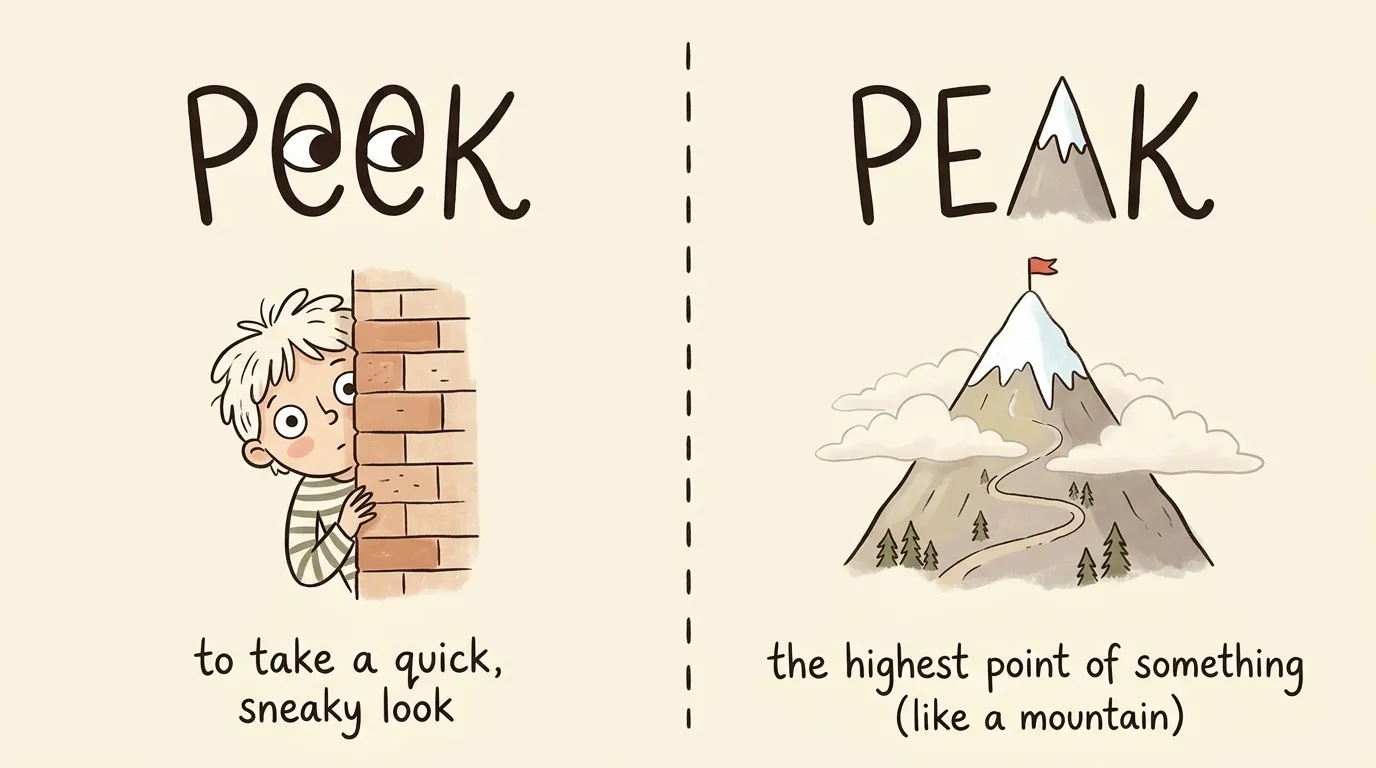
Link each word to a clue in its spelling. Peek has two e’s like two eyes. Peak has an “a” shaped like a mountain top. Pique is the fancy French one.
Here are three simple tricks:
- Peek = two eyes. The two e’s look like eyes. Peeking is looking.
- Peak = the top. Capital A has a pointed top, like a mountain peak.
- Pique = interest. It looks French and fancy. Think “piqued interest.”
Here’s one more.
If you can replace the word with “look,” use peek.
you can replace it with “top” or “highest point,” use peak.
If you can replace it with “spark” or “stir up,” use pique.
Example Sentences
Real examples help you see the three words in action. Notice how the meaning, not the sound, decides the spelling.
Peek (look)
- The puppy peeked out from under the couch.
- Take a peek at the cake before we cut it.
- She peeked at her cards, then smiled.
- Can I get a peek at your notes?
- The sun peeked through the clouds.
- He peeked around the corner to check.
Peak (top, highest)
- We climbed to the peak before noon.
- Ice cream sales peak in July.
- She’s at the peak of her career.
- Rush hour is the peak time for traffic.
- The athlete was in peak shape.
- Fall is peak season for the apple farm.
Pique (spark interest)
- The strange sign piqued my curiosity.
- The teacher told a story to pique their interest.
- Her question piqued his interest.
- He left the room in a fit of pique.
Sneak peek and mixed
- Here’s a sneak peek at our new logo.
- The trailer gave us a sneak peek of the movie.
- She peeked at the mountain peak through the fog.
- The photo piqued my interest, so I took a peek at the full album.
Common Mistakes
Most errors come from three places: “sneak peak,” “peaked my interest,” and “peek” used for the top of a mountain.
❌ Here’s a sneak peak at the new menu. ✅ Here’s a sneak peek at the new menu.
❌ The story peaked my interest. ✅ The story piqued my interest.
The story peeked my interest. ✅ The story piqued my interest.
❌ We hiked to the mountain peek. ✅ We hiked to the mountain peak.
❌ Sales peeked in December. ✅ Sales peaked in December.
He took a peak at her paper. ✅ He took a peek at her paper.
The “peaked my interest” mistake is very common. Many people write it by accident.
Most style guides and editors treat it as an error. Use “piqued.”
Tricky Cases
A few phrases cause extra confusion. Here’s how to handle them.
“Peak” as an adjective.
Peak can describe a time or level: peak season, peak hours, peak performance. It means the highest or busiest.
“Peaked” with two syllables.
You might hear “you look a bit peaked.” In this sense, “peaked” is said with two syllables (PEE-kid). It’s an informal way to say pale or unwell.
Dictionaries list this sense, but check one for your style. It’s best avoided in formal writing.
“Peek” is not a hat.
Some people confuse “peek” with “peak” in “peaked cap.” A peaked cap has a pointed brim. That’s the “peak” meaning.
“Pique” can also mean “irritate.”
If someone is “piqued,” they may be annoyed. For example, “He was piqued by the comment.”
Context tells you which meaning fits.
Peak, peek, and pique in one sentence.
“The mountain peak piqued her interest, so she took a peek through the binoculars.”
All three words work together in that sentence.
When to Use Each Word
Match the word to the meaning. Looking is peek. Top or maximum is peak. Sparking interest is pique.
Use “peek” when you mean:
- A quick or secret look
- A sneak preview
- To glance at something
The “peak” when you mean:
- The top of a mountain
- The highest point or level
- The busiest or best time
Use “pique” when you mean:
- To arouse interest or curiosity
- To irritate or annoy
- A feeling of resentment (noun)
If you’re writing a headline, ad, or email, double-check these words. They’re easy to mix up under deadline.
Expert Tip 💡
Spellcheck can’t catch homophones. Both words are real, so your software stays quiet.
Add one step to your editing. Search your draft for “peek,” “peak,” and “pique.” Then ask what each word means in that sentence.
Reading aloud won’t help, because they sound the same. Reading for meaning will.
Quick Quiz
Test yourself. Answers are below.
- Which is correct: “sneak peek” or “sneak peak”?
- The mystery ___ my curiosity. (peeked / peaked / piqued)
- Traffic ___ at 5 p.m. (peeks / peaks / piques)
Answers:
- Sneak peek
- Piqued
- Peaks
FAQs
1. What is the difference between peek and peak?
Peek means a quick look. Peak means the top or highest point. They sound the same but have different meanings and spellings.
2. Is it “sneak peek” or “sneak peak”?
It’s “sneak peek.” A sneak peek is a quick, early look at something new. “Sneak peak” is a common mistake.
3. Is it “piqued my interest” or “peaked my interest”?
It’s “piqued my interest.” “Pique” means to arouse. Most editors and style guides treat “peaked my interest” as an error.
4. What does pique mean?
As a verb, pique means to arouse interest or curiosity. As a noun, it means a feeling of irritation, as in “a fit of pique.”
5. What does peak mean?
Peak means the top of a mountain or the highest point of something. It can also be a verb (“sales peaked”) or an adjective (“peak season”).
6. Is it “take a peek” or “take a peak”?
It’s “take a peek.” A peek is a quick look. A peak is the top of something.
7. Is it “peeked” or “peaked” for a quick look?
Use “peeked.” For example, “She peeked through the door.” “Peaked” is for reaching a top or maximum.
8. Is “peak” ever an adjective?
Yes. “Peak” can describe the busiest or highest level, as in “peak hours” or “peak performance.”
9. Are peek, peak, and pique homophones?
Yes. They sound the same but have different meanings and spellings. That’s why spellcheck often misses them.
10. Which one should I use in an email or on my website?
Use the one that matches your meaning. Use “peek” for looking, “peak” for the top, and “pique” for sparking interest.
Conclusion
Peek, peak, and pique sound alike but do very different jobs.
A peek is a quick look. A peak is the top. To pique is to spark interest.
Remember the big two: it’s “sneak peek,” and it’s “piqued my interest.”
When you edit, check these words by meaning, not by sound. Spellcheck won’t help here, but a quick pause will.
Use the eye trick for peek, the mountain trick for peak, and the French clue for pique.
Soon you won’t need to think about it at all.

Hi, I’m Olivia Harper. I love turning complex English grammar into simple, practical lessons that help readers write and speak with confidence.