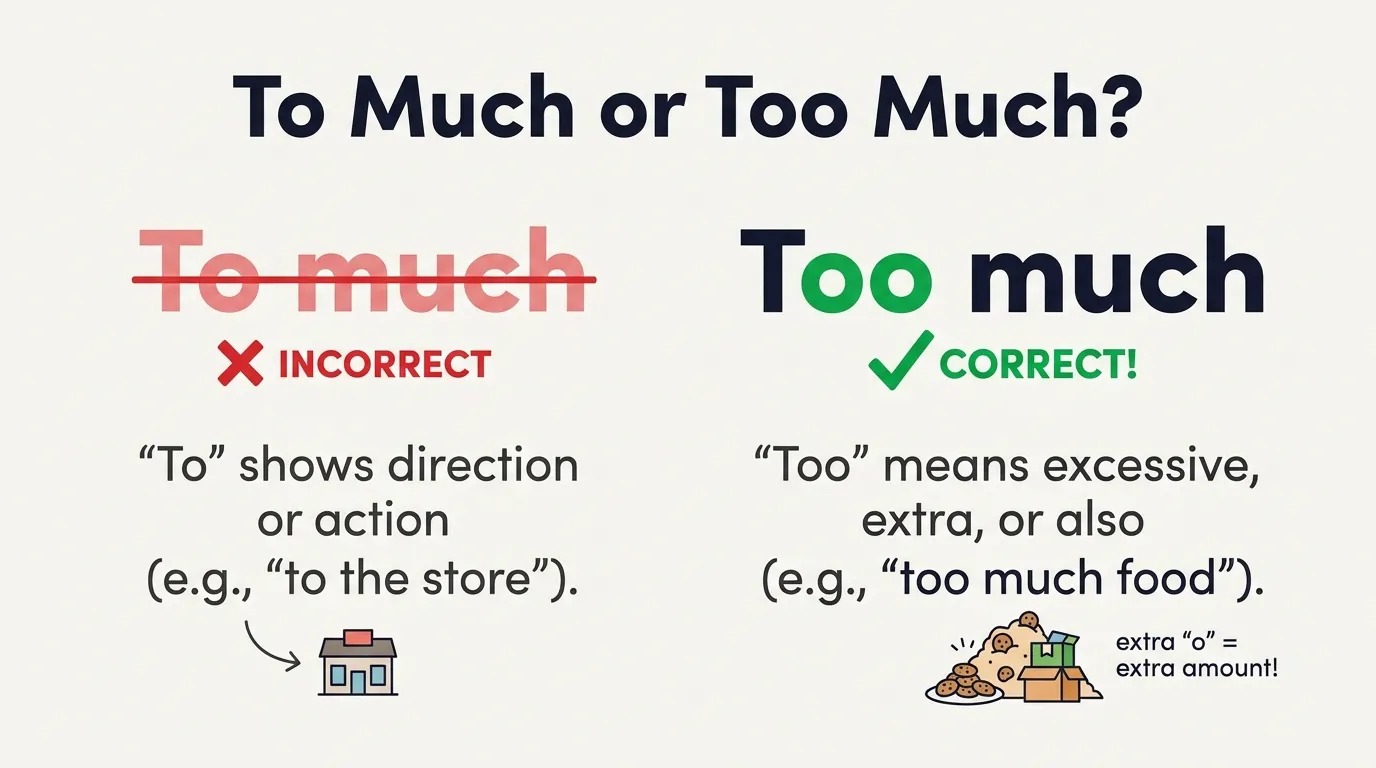
Write “too much” when you mean more than enough. “To much” is almost always a typo.
You’re texting a friend that you ate too much pizza, and autocorrect lets “to much” slip through. It’s embarrassing, but it’s common.
To, too, and two sound exactly alike, so your ear can’t help you.
Here’s the quick fix. If you can swap in the word “excessive,” use too much with two Os. The extra O stands for the extra amount.
There’s one small catch. “To much” can appear in rare sentences where “to” is a preposition and “much” starts a new phrase.
This guide shows you how to spot that case. You’ll also get examples, common mistakes, a comparison with “much too,” and a short quiz.
Table of Contents
- To Much or Too Much? The Difference Explained
- When Is “Too Much” Correct?
- Can “To Much” Ever Be Correct?
- Too Much vs Much Too
- Too Much in Common Phrases
- Memory Trick
- Real Example Sentences
- Common Mistakes
- When to Use Each Form
- Expert Tip
- Quick Quiz
- FAQs
- Conclusion and Key Takeaways
Did You Know? 🔍
“To much” isn’t always wrong. In “She returned home to much the same scene,” the word “to” is a preposition. The word “much” begins a new phrase. Writing Explained uses this kind of example to show that the pairing exists, but rarely.
Quick Answer Box
Use too much when you mean excessive, as in “too much sugar.” Too is an adverb meaning excessively, and much is the amount. “To much” is a spelling error in that case. It’s correct only in rare sentences where “to” is a preposition followed by “much,” like “returned to much the same scene.”
⚡ Quick Rule in 1 Line
If you mean excessive, write “too much” with two Os: an extra O for an extra amount.
To Much or Too Much? The Difference Explained
“Too much” means more than you need, want, or can handle. The word “too” is an adverb meaning excessively, and “much” names the amount. “To much” is a spelling error whenever you mean excess. Choose too much every time you mean that.
The trouble starts because three words share one sound. Here’s how they differ.
| Word | Part of speech | Meaning | Example |
|---|---|---|---|
| to | Preposition or infinitive marker | Direction, purpose, or time | I’m going to the store. |
| too | Adverb | Also, or excessively | That soup is too salty. |
| two | Number | The number 2 | I need two eggs. |
Notice that only “too” can mean excess. That’s why “too much” gets two Os.
The sound is identical, so no ear test works. You have to check the meaning instead.
When Is “Too Much” Correct?
“Too much” is correct whenever you mean an excessive amount. It can work as an adjective (“too much pizza”) or an adverb (“she texts too much”). It can also stand alone (“that’s too much”). The meaning is always more than is needed.
Here are the four common patterns:
- Before a noun: We have too much homework tonight.
- After a verb: He talks too much in class.
- On its own: Fifty dollars is too much for that shirt.
- With “of”: That’s too much of a risk for me.
In every case, you could replace the phrase with “an excessive amount” and still make sense. That swap test is your best tool.
Writing Explained gives similar examples. “Too much work and not enough play” works because “too” signals the excess.
Can “To Much” Ever Be Correct?
Yes, but rarely. “To much” is correct only when “to” is a preposition and “much” begins a new phrase. In these sentences, the two words aren’t a unit. They just happen to sit side by side.
Look at these real-style cases:
- She returned home to much the same scene.
- My niece doesn’t say yes to much.
- I’m not used to much noise.
In each one, you can read “to” with the word before it (“returned home to,” “say yes to,” “used to”). Then “much” joins the words after it. It doesn’t mean “excessive.”
Here’s a simple test. If “excessive” fits, write too much. If “to” connects to a verb or place before it, “to much” may be right.
Be honest with yourself, though. Most people who type “to much” meant “too much.” The legitimate cases are uncommon. WritingTips calls the pairing generally unused.
Too Much vs Much Too
“Too much” describes an amount of something. “Much too” strengthens an adjective or adverb. Use too much before nouns and after verbs. Use much too before words like hot, late, or quickly. The two phrases aren’t swappable.
This is a standard grammar pattern, and it trips up many learners.
| Phrase | What it modifies | Example |
|---|---|---|
| too much | A noun or a verb | You added too much salt. |
| much too | An adjective or adverb | The soup is much too salty. |
| too much | A verb | She worries too much. |
| much too | An adverb | He drove much too fast. |
If you’re unsure, try replacing the phrase with “very.” You can say “very salty,” so “much too salty” fits.
Too Much in Common Phrases
Too much also appears in fixed phrases and everyday sayings. In each one, “too” still means excessively, so it keeps two Os. Learning these phrases helps you see the pattern and spot the right spelling quickly.
- Too much of a good thing: Even your favorite song gets old if you play it too much.
- Too much information: His story had too much information for a short email.
- Too much to handle: The schedule felt like too much to handle this week.
- Too much on my plate: I’ve got too much on my plate right now.
Each phrase describes an excess. That’s the clue that tells you to write too much with two Os.
In longer writing, try to vary your wording. Words like “excessive,” “overly,” and “far more than needed” can replace “too much” when it repeats. Still, “too much” is the plain, friendly choice, and it works well in most everyday writing.
Memory Trick
Think of the extra O as an extra serving. “Too” has one more O than “to,” and “too much” means one more helping than you need. The extra letter matches the extra amount.
Grammarly suggests another quick test. Replace the word with “also,” “very,” or “excessively.” If one fits, use the spelling with the extra O.
Here’s how to use both tricks:
- Ask: does “excessive” fit?
- If yes, write too much.
- If no, check whether “to” connects to a verb or place before it.
That’s the whole check, and it takes five seconds.
Real Example Sentences
These sentences are grouped by use, so you can see each pattern clearly.
before a noun Too much
- I drank too much coffee this morning.
- There’s too much traffic on the highway.
- We have too much food for six people.
- Too much sun can burn your skin.
Too much after a verb
- My brother talks too much at dinner.
- Don’t worry too much about the test.
- She works too much and sleeps too little.
- They spent too much on the trip.
Too much on its own
- Fifty dollars for a notebook is too much.
- That’s too much for one person to carry.
- Is it too much if I ask for help?
- The noise was just too much.
Much too (for comparison)
- The room is much too warm.
- He answered much too quickly.
- This coat is much too small for me.
Rare legitimate “to much”
- She returned home to much the same scene.
- My niece doesn’t say yes to much.
- I’m not used to much noise.
- He said no to much of the plan.
Common Mistakes
The most common mistake is writing “to much” when you mean “excessive.” Another is mixing up “too much” and “much too.” Readers notice both. Here’s what to watch for.
❌ I have to much homework. ✅ I have too much homework.
❌ Don’t spend to much money. ✅ Don’t spend too much money.
She talks to much. ✅ She talks too much.
❌ The tea is too much hot. ✅ The tea is much too hot.
❌ It’s to much for me. ✅ It’s too much for me.
I want to much of it. ✅ I want too much of it. (Or, if you mean “I want to eat much of it,” rewrite for clarity.)
When to Use Each Form
Use too much for excess. Use to for direction, purpose, or the start of an infinitive.
The Use two for the number. Use “to much” only when “to” is a preposition for a phrase that follows it. When in doubt, test with “excessive.”
| Situation | Best choice |
|---|---|
| Something is more than needed | too much |
| Something modifies an adjective | much too |
| Direction or purpose | to |
| The number 2 | two |
| “To” ends a phrase before “much” | to much (rare) |
If you’re writing quickly, search your draft for “to much.” Then read each hit aloud and apply the swap test.
Expert Tip 💡
Run a find-and-replace for “to much” before you publish. Review each result by hand, and change it to “too much” unless “to” clearly belongs to the words before it. This ten-second step catches the most common typo in this pair.
Engagement Add-On: Quick Quiz
1. Which sentence is correct? a) I ate to much cake. b) I ate too much cake. c) I ate two much cake.
2. Pick the right phrase: “The coffee is ___ hot.” a) too much b) much too
3. Which sentence uses “to much” correctly? a) I’m not used to much noise. b) I have to much work. c) That’s to much for me.
Answers: 1) b, 2) b, 3) a.
FAQs
1. Is it to much or too much?
Use “too much” when you mean excessive. “To much” is a spelling error in that case. It’s correct only in rare sentences where “to” is a preposition.
2. Is “to much” ever correct?
Yes, but rarely. For example, “returned home to much the same scene” is correct. Here “to” belongs to the verb phrase, and “much” starts a new phrase.
3. What does “too much” mean?
It means more than is needed or wanted. For example: “That’s too much sugar for me.”
4. Why do people write “to much”?
To, too, and two sound the same. Autocorrect and fast typing also let the mistake through.
5. What’s the difference between to, too, and two? “To” shows direction or purpose. “Too” means also or excessively. “Two” is the number 2.
6. Is “too much” an adverb or an adjective?
It can work as either. In “She talks too much,” it acts like an adverb. In “too much pizza,” it acts like an adjective before a noun.
7. What’s the difference between too much and much too?
“Too much” goes with nouns and verbs. “Much too” goes with adjectives and adverbs, as in “much too late.”
8. How can I remember which spelling to use?
Think of the extra O as the extra amount. You can also swap in “excessive.” If it fits, write too much.
9. Can I write “too much of”?
Yes. For example: “That’s too much of a risk.” It means an excessive portion of something.
10. Is “to much” a word? It isn’t a single word. It’s two separate words that appear together in rare cases, like “returned to much the same scene.”
Conclusion
So, is it to much or too much? When you mean excessive, write “too much” with two Os. The extra O is your reminder of the extra amount.
Remember the one rare exception. “To much” is fine when “to” belongs to a preposition phrase and “much” begins the next one. For example, “I’m not used to much noise” is correct.
Here’s your plan. Ask whether “excessive” fits. If it does, write too much. Then use “much too” before adjectives and adverbs.
That small habit clears up nearly every mistake, and your writing will look polished and careful. You’ll stop second-guessing every message you send.

Hi, I’m Daniel Carter. I’m passionate about helping learners improve their English with practical grammar tips and clear writing advice.